
How to Calculate Futures Position Size in Seconds (Free Chrome Tool)
You’re ready to enter a trade on NQ futures. Your finger hovers over the buy button. But wait, how many contracts should you actually trade? You grab your calculator, open a spreadsheet, or worse, you guess based on what feels right.
Sound familiar? If you’ve ever blown through your account because you traded too many contracts, or left money on the table by trading too few, you’re not alone. Position sizing is the difference between consistent profits and blown accounts, yet most traders still wing it.
Here’s the truth: calculating the correct position size for futures contracts doesn’t need to be complicated, time consuming, or done on a clunky spreadsheet. In fact, with the right tool, you can calculate your exact position size in under three seconds, right from your browser toolbar.
Why Position Sizing Matters More Than Your Entry Point
Most new traders obsess over finding the perfect entry. They’ll spend hours analyzing charts, waiting for the ideal setup, and then completely ignore how many contracts they should trade. This is backwards thinking.
Professional traders know a secret that beginners don’t: your position size determines your risk more than your entry point ever will. You can have the best entry in the world, but if you’re trading 10 contracts when you should be trading 2, one bad day can wipe out weeks of gains.
Consider this scenario. You have a $50,000 account and want to risk 1% per trade, which is $500. You’re trading NQ E-mini futures with a 10 point stop loss. How many contracts can you trade?
If you said “I’ll figure it out later,” you’re already making a critical mistake. The math matters. Each point on NQ E-mini is worth $20 per contract. With a 10 point stop, you’re risking $200 per contract. That means you can trade 2 contracts to stay within your $500 risk limit. Trade 3 contracts, and you’re risking $600, which is 1.2% of your account instead of 1%.
This might not seem like much, but over hundreds of trades, this kind of sloppy position sizing compounds. Before you know it, you’re taking 2% or 3% risk without realizing it, and one bad streak ruins your account.
The Old Way: Spreadsheets and Manual Calculations
For years, serious traders used Excel spreadsheets to calculate position sizes. You’d input your account size, risk percentage, stop loss, and the spreadsheet would spit out a number. Some traders even printed laminated cards with position sizes for different scenarios.
The problem? It’s slow. Markets move fast, especially in futures. By the time you’ve opened your spreadsheet, found the right tab, input your numbers, and calculated the result, the perfect setup might be gone. Or worse, you’ve already entered the trade with the wrong size because you were in a hurry.
Then there’s the human error factor. Maybe you forget to update your account size after a winning streak. Maybe you input 15 points instead of 10 for your stop loss. Maybe you’re trading at 2am during a volatile overnight session and your brain isn’t working at full capacity. Small mistakes lead to big losses.
Introducing the Futures Position Calculator Chrome Extension
What if you could calculate your exact position size in literally two seconds, without ever leaving your trading platform? That’s exactly what our free Chrome extension does.
Instead of opening spreadsheets or doing mental math, you click one icon in your browser toolbar, input four simple numbers, and get your answer instantly. No formulas to remember. No spreadsheets to maintain. No room for error.
How It Actually Works
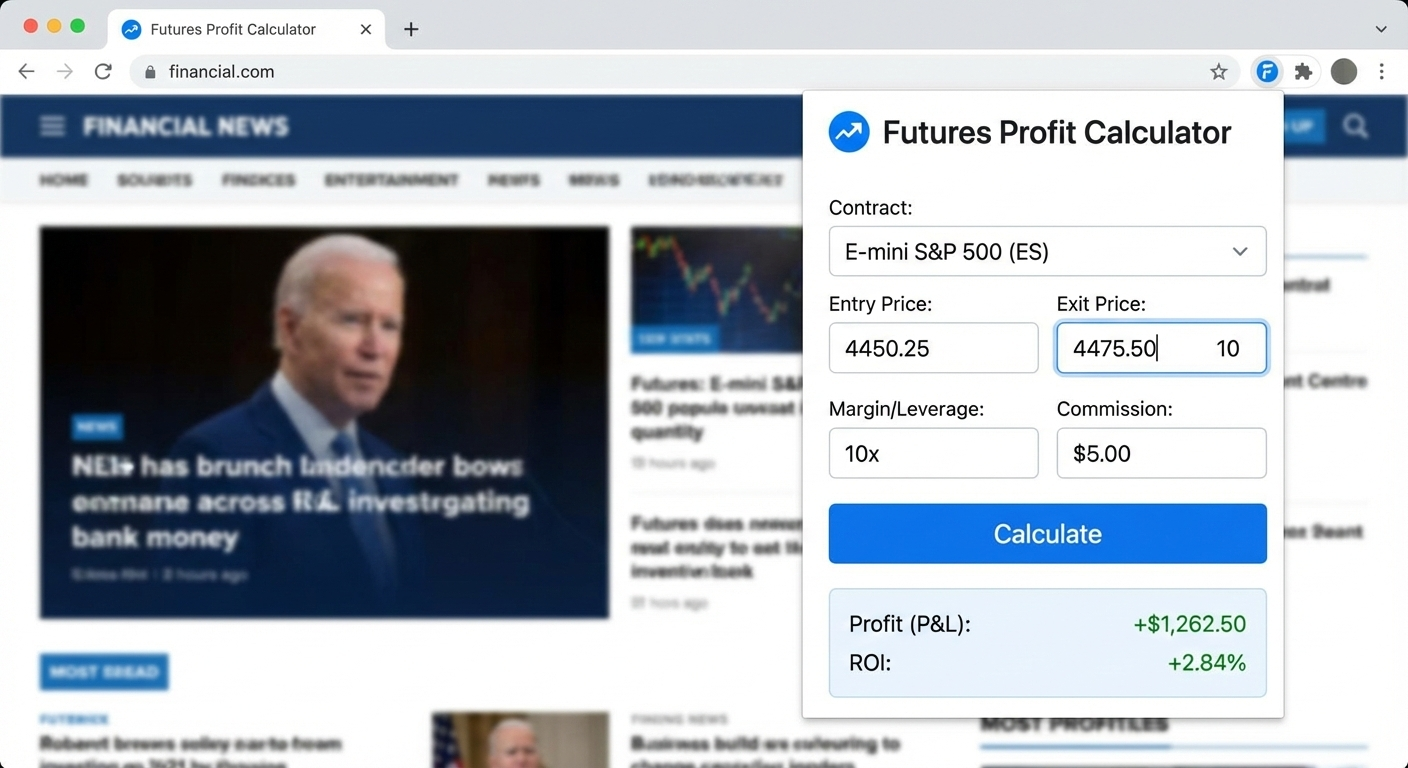
The extension sits quietly in your browser toolbar until you need it. When you’re ready to enter a trade, you click the icon and you see a simple interface with four fields:
- Contract Type: Select from NQ Micro, NQ E-mini, ES, YM, RTY, CL, GC, and more
- Account Size: Your current trading account balance
- Stop Loss: How many points you’re risking on this trade
- Risk Percentage: What percent of your account you want to risk
Click calculate, and boom. You get three pieces of critical information:
- Exactly how many contracts to trade
- Your total dollar risk for the trade
- Profit targets at 1:1, 1:2, and 1:3 risk/reward ratios
The entire process takes three seconds. Your settings are automatically saved, so next time you open it, your account size and preferred risk percentage are already filled in. Just update your stop loss, hit calculate, and you’re done.
Why Futures Traders Are Switching to Browser Based Tools
The trading tool landscape is changing. Five years ago, everyone used Excel spreadsheets or dedicated desktop software. Today, professional traders are moving to browser based tools for three main reasons.
Speed and Accessibility
Your browser is always open when you’re trading. You’re probably watching TradingView charts, checking economic calendars, or reading trading forums, all in Chrome. Having your position calculator in the same ecosystem means zero friction. No alt tabbing to Excel. No launching separate programs. Just click, calculate, trade.
Plus, it works anywhere. Trading from your home office? It’s there. Checking positions from your laptop at a coffee shop? Still there. The calculator follows you wherever Chrome goes, with all your saved settings intact.
No Maintenance Required
Spreadsheets break. Formulas get accidentally deleted. Files corrupt. Desktop software needs updates. With a Chrome extension, updates happen automatically in the background. You never have to think about whether you’re using the latest version or if your formulas are still correct.
The contract specifications are built in and accurate. NQ E-mini is $20 per point. ES E-mini is $50 per point. YM is $5 per point. You don’t need to remember these or look them up, they’re already programmed correctly.
Privacy and Security
Here’s something most traders don’t think about: cloud based calculators require you to send your account size and trading information to someone else’s server. Who knows what they’re doing with that data? Are they selling it? Tracking your trading patterns? Building a profile on you?
With a browser extension that stores everything locally, your data never leaves your computer. No accounts to create. No emails to verify. No privacy policy to worry about. Your trading information is yours alone.
Real Examples: Position Sizing Across Different Futures Markets
Let’s walk through real world examples of how position sizing changes based on the contract you’re trading. Understanding these differences is crucial because many traders make the mistake of using the same position size across different markets.
Example 1: NQ E-mini (Nasdaq Futures)
You have a $25,000 account and want to risk 1% per trade, which is $250. You’re trading NQ E-mini with a 15 point stop loss. Each point is worth $20, so your risk per contract is $300. Can you even take this trade?
The answer is no, not with proper position sizing. One contract puts you at $300 risk, which is 1.2% of your account. This is where new traders make mistakes. They think “close enough” and take the trade anyway. But that extra 0.2% compounds over time.
Your options: tighten your stop to 12 points ($240 risk), switch to NQ Micro contracts (which are 1/10th the size), or skip the trade and wait for a better setup with a tighter stop.
Example 2: ES E-mini (S&P 500 Futures)
Same $25,000 account, same 1% risk. You’re trading ES E-mini with a 10 point stop. Each point is worth $50, so your risk per contract is $500. This puts you at 2% risk, double your target.
Notice how ES requires tighter stops than NQ for the same account size? This is because ES has a higher dollar value per point. Many traders don’t account for this and end up overtrading ES relative to their account size.
Example 3: Crude Oil (CL)
Now you’re trading crude oil futures with the same account. CL moves in ticks worth $10 each, and a full point is $1,000. If you put a 1 point stop loss on CL with a $25,000 account, you’re risking 4% on a single trade, which is way too much.
This is why many retail traders get destroyed in the oil markets. They apply the same position sizing logic they use for ES or NQ, not realizing that CL is significantly more volatile and has much larger dollar values per point.
Common Position Sizing Mistakes That Cost Traders Money
After working with hundreds of futures traders, I’ve noticed the same mistakes show up again and again. Here are the big ones that are quietly destroying trading accounts.
Mistake 1: Using the Same Position Size for Every Trade
Just because you can trade 5 contracts of NQ doesn’t mean you should trade 5 contracts on every setup. Your position size should adjust based on your stop loss distance and current market volatility.
A trade with a 5 point stop should have a larger position size than a trade with a 20 point stop, assuming you’re risking the same dollar amount. But most traders pick a number of contracts they’re comfortable with (usually based on emotion, not math) and stick with it regardless of the setup.
Mistake 2: Rounding Up “Just a Little Bit”
The calculator says 3.7 contracts, so you round up to 4. It’s only 0.3 contracts difference, right? Wrong. That extra 0.3 contracts represents real money and real risk that you didn’t account for in your trading plan.
Professional traders always round down, not up. If the math says 3.2 contracts, you trade 3. If it says 1.8 contracts, you trade 1. This ensures you never exceed your maximum risk tolerance, even by a little bit.
Mistake 3: Forgetting to Update Account Size
You start the month with $50,000. You have a good week and you’re up to $54,000. But you’re still calculating position sizes based on $50,000, which means you’re undertrading and leaving money on the table.
Conversely, if you’re down to $46,000 but still calculating sizes based on $50,000, you’re overtrading relative to your actual account size. This asymmetry kills accounts slowly but surely.
The solution? Update your account size regularly. With our Chrome extension, your settings are saved, so updating your account size once a week takes literally five seconds.
Mistake 4: Ignoring Correlation Between Positions
You calculate perfect position sizes for a long position in ES and a long position in NQ. You’re risking exactly 1% on each trade. But here’s the problem: ES and NQ are highly correlated. If the market drops, both positions lose money simultaneously.
Your actual risk isn’t 2% (1% plus 1%). It’s closer to 1.8% or 1.9% because the positions move together. Advanced traders adjust their position sizes downward when trading correlated markets to account for this hidden risk.
| Contract | Point Value | Account Needed for 1 Contract (1% risk, 10 point stop) |
|---|---|---|
| NQ Micro | $2 | $2,000 |
| NQ E-mini | $20 | $20,000 |
| ES Micro | $5 | $5,000 |
| ES E-mini | $50 | $50,000 |
| YM Micro | $0.50 | $500 |
Minimum account sizes needed to trade one contract with proper 1% risk management
How to Set Up Your Position Sizing Workflow
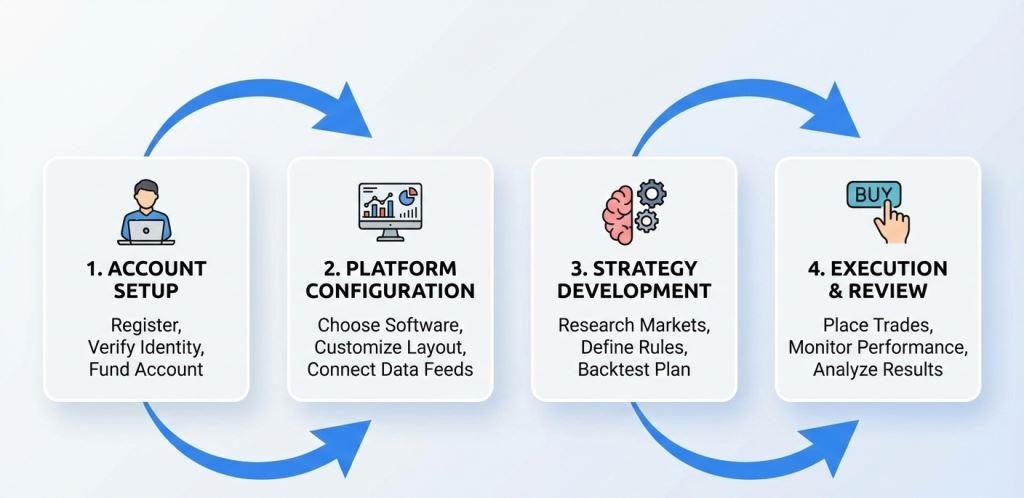
Having the right tool is only half the battle. You also need a repeatable workflow that ensures you calculate position sizes correctly every single time, no exceptions. Here’s the exact process professional traders use.
Step 1: Identify Your Setup
Before you even think about position sizing, you need a valid trading setup. What’s your entry? What’s your stop loss? What’s your profit target? If you can’t answer these questions clearly, you’re not ready to calculate position size because you don’t have a complete trade plan yet.
Step 2: Determine Your Stop Loss in Points
This is non negotiable. You must know your exact stop loss distance in points before calculating position size. “Somewhere around 10 points” doesn’t cut it. Is it 8 points? 10 points? 12 points? The difference matters.
Your stop loss should be based on the market structure, not on how many contracts you want to trade. Find a logical place for your stop (below a support level, above a swing high, etc.), measure the distance, and use that number.
Step 3: Calculate Your Position Size
Now you’re ready to calculate. Open your futures position calculator, input your account size, select your contract type, enter your stop loss in points, and set your risk percentage. Hit calculate and you get your answer instantly.
Write this number down or memorize it. Don’t calculate it and then second guess it. The math is the math. If it says 2 contracts, you trade 2 contracts. If it says 7 contracts, you trade 7 contracts.
Step 4: Verify Before Entering
This is the step most traders skip. Before clicking the buy or sell button, take five seconds to verify your position size. Check your order ticket. Does it show the correct number of contracts? Is it a buy or a sell? Is your stop loss order placed correctly?
Sounds obvious, but you’d be amazed how many traders calculate 3 contracts and then accidentally enter 30 contracts because of a typo. Or they calculate for a long trade but enter a short trade because they weren’t paying attention.
Advanced Tips: Getting More From Your Position Calculator
Once you’ve mastered the basics, there are several advanced techniques that can help you get even more value from accurate position sizing.
Scaling Into Positions
Instead of entering your full position size at once, consider scaling in with multiple entries. For example, if your calculator says 6 contracts, you might enter 2 contracts at your first entry point, 2 more if the trade moves favorably, and the final 2 contracts at a third entry.
This requires recalculating your position size for each entry, adjusting for your new average entry price and stop loss location. It’s more work, but it can significantly improve your win rate and reduce your average risk per trade.
Adjusting for Market Conditions
Your standard risk might be 1% per trade, but what about during extremely volatile periods? Many professional traders reduce their position sizes to 0.5% or 0.75% risk during high volatility periods like FOMC announcements or major economic releases.
The calculator makes this easy. Instead of risking 1%, just change it to 0.5% and recalculate. Your position size automatically adjusts to maintain the lower risk level.
Using Risk/Reward for Position Scaling
Here’s an advanced technique: adjust your position size based on the quality of the setup. If you have a high probability setup with great risk/reward (1:3 or better), you might risk 1.5%. If it’s a lower probability setup with mediocre risk/reward, you might reduce risk to 0.5%.
This approach requires honest self assessment of your setups, but it can dramatically improve your overall profitability by putting more capital into your best trades and less into your marginal trades.
Why Professional Traders Never Skip Position Sizing
If you spend time around successful futures traders, you’ll notice something interesting. They might have different strategies, trade different timeframes, and focus on different markets, but they all have one thing in common: they calculate position size for every single trade.
According to risk management research from Investopedia, proper position sizing is one of the three pillars of successful trading, alongside a solid strategy and emotional discipline.
It’s not because they’re being extra cautious or overly conservative. It’s because they understand something that beginners don’t: trading is a game of probabilities played with real money. Even the best strategy has losing trades. The question isn’t whether you’ll have losses, it’s whether those losses will end your trading career.
Proper position sizing ensures that no single trade, no single day, and no single week can blow up your account. You might have a bad month. You might even have a bad quarter. But with disciplined position sizing, you live to trade another day, and that’s what separates professionals from the 90% who fail.
Getting Started: Your Action Plan
Knowledge without action is useless. Here’s exactly what you should do right now to improve your position sizing and protect your trading account.
Immediate Actions (Do This Today)
- Calculate your maximum risk per trade: Take your account size and multiply by 1% (or 2% if you’re more aggressive). This is the maximum dollar amount you should risk on any single trade.
- Review your last 10 trades: Go back and check if you were actually following proper position sizing. Were you risking more or less than your target? The results might surprise you.
- Install a position calculator: Whether it’s our Chrome extension or another tool, get something that makes calculations instant and effortless. Spreadsheets are better than nothing, but instant tools are better than spreadsheets.
This Week’s Goals
- Calculate position size for every trade you take, no exceptions
- Keep a log of your calculated position sizes versus what you actually traded
- Identify patterns where you deviate from the calculated size (are you consistently overtrading certain setups?)
- Update your account size in your calculator at least once this week
Long Term Habits
Building good position sizing habits takes time, but it’s worth it. After a few weeks of calculating position sizes correctly for every trade, it becomes automatic. You stop thinking about whether you should calculate and just do it instinctively.
The Commodity Futures Trading Commission (CFTC) recommends that all futures traders maintain strict risk management protocols, including proper position sizing, to protect themselves from significant losses.
Track your progress. After 30 days of disciplined position sizing, compare your results to the previous 30 days. You’ll likely notice smaller losing trades, more consistency in your returns, and less emotional stress about each individual trade.
Ready to Trade Smarter?
Join thousands of futures traders using our free Chrome extension to calculate position sizes instantly. No spreadsheets, no manual math, no room for error.
Conclusion: Math Beats Emotion Every Time
Trading futures is hard enough without making it harder by guessing your position sizes. The difference between successful traders and those who blow up their accounts often comes down to this one factor: successful traders know exactly how many contracts to trade on every setup, and they stick to it religiously.
The good news is that position sizing doesn’t have to be complicated, time consuming, or stressful. With the right tools, it takes three seconds and removes all emotion from the equation. The math tells you exactly what to do, and you simply follow the math.
Your entry points will never be perfect. You’ll miss moves. You’ll have losing streaks. That’s all part of trading. But if you never risk more than you can afford to lose on any single trade, you’ll survive long enough to become consistently profitable. And that’s the entire goal.
Start calculating your position sizes correctly today. Your future self, and your trading account, will thank you.